Ok, a couple of years hiatus from posting stuff that might interest folks about our school seems like it's long enough. I also get that facebook is now used mainly by old people like me... so let's start with this notice about money you could get if you are female and applied for this scholarship and are in, or applying for our ADGIS and/or BGIS.
https://www.ikbbc.ca/women-in-tech/about-this-scholarship/
Thursday, March 14, 2019


Thursday, March 17, 2016
Integrated Environmental Planning Class Open House
Great turnout for the IEP programs Rossland Life and Environment Action Plans Open House on Monday March 14, at the Old Fire Hall. Here are our student reps thanking the crowd that provided input to the student's plans over a two hour period. Great job, all!

Wolverines!
Awesome talk by Nikki Hiem in early Jan on her MSc work on the cumulative effects of landscape disturbance, climatic conditions, interspecific species interactions and more. Nikki finished our RFW program in 2004, volunteered on a variety of research projects, finished her degree at TRU and completed her masters at UVIC. She now works in Banff National Park. Nice to see that our past grads are getting into interesting research!

Wednesday, March 11, 2015
Interesting talk in the ADGIS lab today, with Will Burt, Regional Geomatics Analyst Kootenay Boundary Region, Ministry of Forests, Lands and Natural Resource Operations (MFLNRO). He talked about the role GIS plays in forest fire management, and about the kinds of things you do, day to day, in an Incident Command Team.
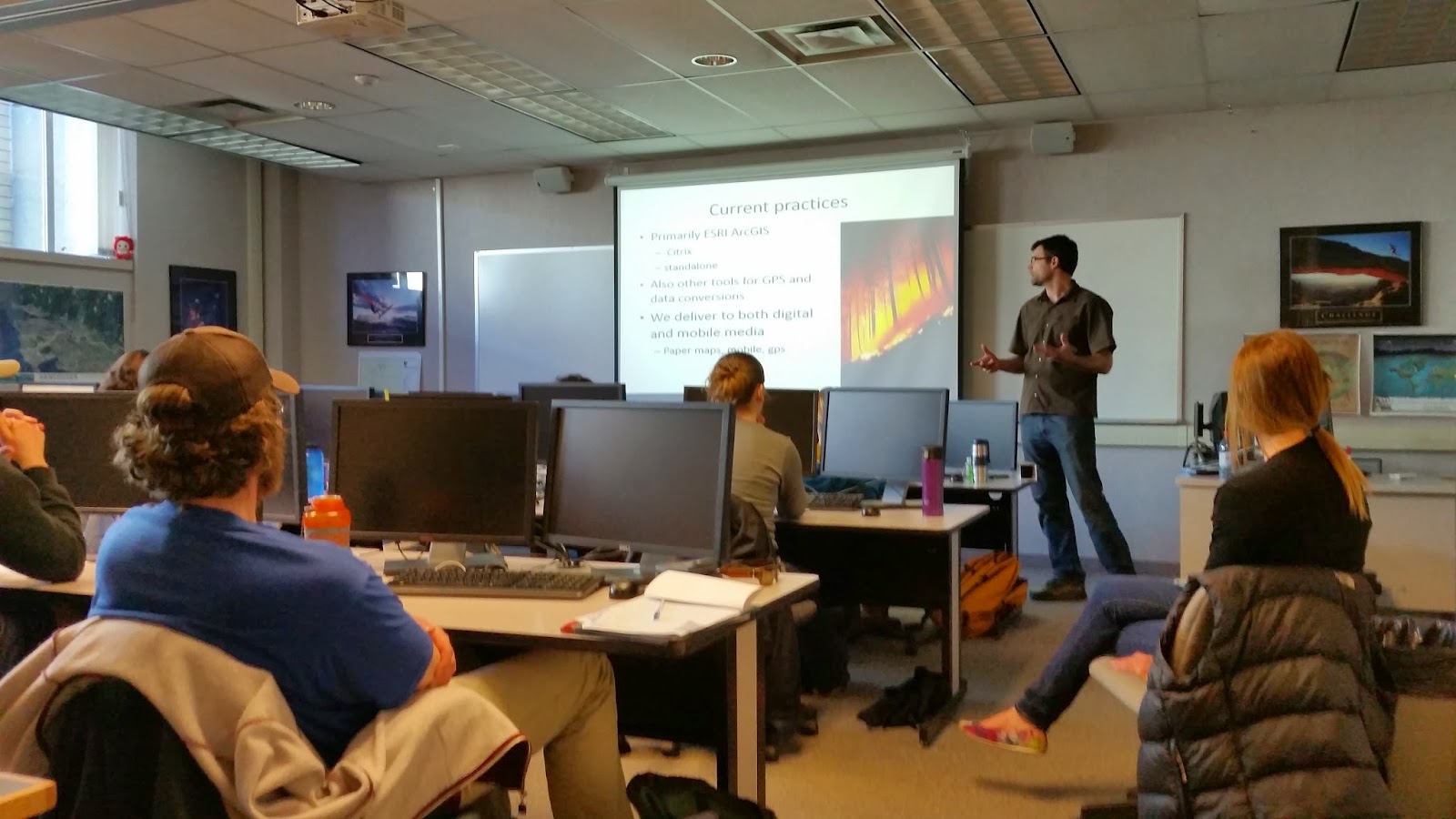
It was a nice connection to where some of these students will go - several past grads have had coop jobs at the the Southeast Fire Centre. Also it was nice to see a number of the students in this group that have come through the geomatics courses that our two year diploma students take.
It was a nice connection to where some of these students will go - several past grads have had coop jobs at the the Southeast Fire Centre. Also it was nice to see a number of the students in this group that have come through the geomatics courses that our two year diploma students take.
 |
| Rena Vandenbos instructing a second year forestry GIS lab |
Thursday, January 8, 2015
We're almost at the New Year here, but there's been a lot of interesting events our SEG students have experienced over the last four months, and I though I should mention at least a few of them!
Doris Hausleitner and I took the 2nd year IEP students up to Stagleap Provincial Park to help monitor whitebark pine population health, and to look at the change in forest structure over an elevation gradient (from the Pass car park to the top of Cornice Ridge).
Like last year, we hoofed it up to the top of the ridge for a view. Then we set up fixed area plots to record tree density and other measures of forest structure.
An important part of the lab is to assess the extent of blister rust infection in the whitebark pine population. This species of pine is listed as endangered in Canada, and I've worked on it's conservation and restoration it's high elevation habitat since 1997. It's great to get students introduced to, and working on this problem every year.
Doris Hausleitner and I took the 2nd year IEP students up to Stagleap Provincial Park to help monitor whitebark pine population health, and to look at the change in forest structure over an elevation gradient (from the Pass car park to the top of Cornice Ridge).
 |
| Cornice Ridge leads up from the right to the little peak above the van |
 | |
|
 |
| Students getting to work recording forest structure data on the site |
 |
| Looking at infected whitebark pine saplings |
Monday, October 27, 2014
Here's a little Castlegar News piece from a week ago week when the Minister of Technology, Innovation and Citizens' Services stopped by the College for a look at the Selkirk Geospatial Research Centre (SGRC) and the Rural Development Institute (RDI). I was out of town, but apparently Andrew Wilkinson was impressed by the research and innovation efforts he saw (how could he not?). Hats of to Ian, Terri, and their respective teams!

Tuesday, October 21, 2014
I went out recently with SEG's fisheries biologist/instructor Rena Vandenbos to prepare for RFW field lab. We when back to the same area up the Kootenay River north of Castlegar and set traps up Glade Creek. Here's Rena and our young assistant placing several of the traps.

Adriana tying in a submerged trap

Here's what the trap looks like in situ.

On our way the last trap placement, Adrian spotted this locally rare bull trout. Got to love water resistant cell phones... I'm using a Samsung S5, and I've been pretty happy with the camera results. This is in a forest with low Fall evening light and me just holding the phone under and clicking - no post production.

The end result was for the lab was no bull trout caught in the traps, but lots of rainbow fry. Always pays to keep your eyes open for other information outside of your experimental design - makes for some great new questions to ask.
Thursday, August 21, 2014
Catch up!
Catch up.
Ok, one a year does not make a blog! So much happened over the last year at the College and the applied environmental field in the Kootenays, it's a bit over whelming to report out on, but there is lots of cool stuff that I've meant to share, so I'm going to take a few posts here to show off, mostly with images. Here we go...
Every fall instructors in our RFW program have to get ready for fall RFW field school. Part of these 10 days are spent working on measuring fish populations.
In October last year, Doris Hauslietner and I took her IEP 260 class up on Cornice Ridge in Stageleap Provincial Park to do some vegetation monitoring with with the Parks staff, and to assess the whitebark pine population health in that area.
Ok, one a year does not make a blog! So much happened over the last year at the College and the applied environmental field in the Kootenays, it's a bit over whelming to report out on, but there is lots of cool stuff that I've meant to share, so I'm going to take a few posts here to show off, mostly with images. Here we go...
Every fall instructors in our RFW program have to get ready for fall RFW field school. Part of these 10 days are spent working on measuring fish populations.
 |
| Rena and her young research assistant, Adriana, setting up minnow traps |
In October last year, Doris Hauslietner and I took her IEP 260 class up on Cornice Ridge in Stageleap Provincial Park to do some vegetation monitoring with with the Parks staff, and to assess the whitebark pine population health in that area.
 |
| Unloading at top of the Salmo-Creston Pass |
 |
| Students getting to more open vegetation on Cornice Ridge. |
 |
| Doris and her students assessing blister rust damage on whitebark saplings in one of the vegetation plots. |
 |
| Students setting up a plot and assessing vegetation cover using a line intercept method. |
 |
| Don't do this unless you work for Parks! Here's an old unexploded avalanche bomb. First one I've come across in many years of vegetation monitoring in that area. |
 |
| IEP class of 2013/14! |
Monday, September 16, 2013
Orientation 2013
Lots of stuff has been happening, but there's never enough time to post it! So here's a few tidbits from orientation week...
 |
| Pete and Keyes getting the cross cut competition started. |
 |
| SEG students get to know one another |
 |
| Lining up first and second years to form learning teams |
 |
| Sage advice from Rob Macrae at the MIR centre |
 |
| Your truly listening to students given sage advice |
 |
| Lui Marinelli reflecting on that advice... |
 |
| Scholarship winners, Cali and Laura, with friends and instructors |
 |
| SEG second and third year scholarship winners: Ezra, Heidi, Mandy, Cali, and Laura! |
Wednesday, March 13, 2013
Castlegar News - Students chip in with city planning
Here's where our second year IEP class are presenting their findings from their year long study. Good work folks!
Castlegar News - Students chip in with city planning
Castlegar News - Students chip in with city planning
Wednesday, September 19, 2012
Alpine larch
A call from Don Pigott from Yellow Point Propagation provided a much needed excuse for a subalpine escape. Don wanted mature larch cones. The details were to find a sample of viable seeds from 10 individuals in two separate stands. Adrian Leslie and I decided to pick a relatively close by and familiar location to look for some these samples - above Whitewater ski hill, in Ymir Basin.
Once up to the shorter trees that we could access with our pruning pole, we discovered that other seed predators were well at work.
This critter was probably Strobilomyia macalpinei, something that I found a fair amount of in the stands I suveyed in the Rockies.
This was a classic open, timberline stand, where avalanche disturbance and deep spring snow packs allowed the larch to continuously regenerate among surviving older seed producers. The other high elevation species, spruce, fir, and whitebark pine were relegated to protected ribbons below rock outcrops, or mature larch groups.
 |
| Leaving the ski runs below Ymir Basin |
 |
| Adrian and Ellie looking for trees that had cones |
 |
| Adrian inspecting a poorly developed cone |
 |
| A problem...fly larvae were already harvesting the seeds! |
 |
| An old vet.. |
This was a classic open, timberline stand, where avalanche disturbance and deep spring snow packs allowed the larch to continuously regenerate among surviving older seed producers. The other high elevation species, spruce, fir, and whitebark pine were relegated to protected ribbons below rock outcrops, or mature larch groups.
In the end, a dissapointing cone crop - but a beautiful day out in the mountains and great break from the office!
 |
| Me clipping off cones, using a pruning pole. |
 |
| Another cone with a smaller larvae instar |
 |
| Two well developed cones, and a short shoot that couldn't make up its mind whether to be a cone or a branch |
 |
| A local resident (marmot) checking us out |
Tuesday, September 18, 2012
Orientation 2012
Well, we're at it again for 2012! So far there there are 85 new students spread over four diploma and one degree program in the School. We've had the College wide orientation, our own get together with first and returning second year students, the first week of field trips, forestry bridge installations, getting to know LANs, servers, and GIS.
For me, it's been a lot learning in my new role as the Chair of the SEG. I've been getting to know a whole lot of College staff that I never really appreciated before - an eye opener!
 |
| SEG faculty assistant, Leanne Reitan and I, manning the orientaiton both |
 |
| new students vying for cross-cut champions title! |
 |
| Our new SEG crowd getting treasure hunt instructions |
Friday, February 3, 2012
A New Year.
 Feb 2012 - It's been a busy time since Field School last spring. Right now I'm a month in teaching a revitalized forest ecology - now terrestrial ecology and biology course. For the first couple of weeks students and I have been out on the college campus learning how to identify shrubs in winter,
measuring different tree plantations, and observing evidence of out-of-season wildlife wandering around in the warmer temperatures that we've experienced this January.

more recently, this class moved up to the Nancy Greene Lake area, west of Castlegar, to examine forest structure and ways of measuring site productivity.

Folks have been busy staring through prisms, rapping DBH tapes around trees, estimating stand ages, and generally having fun! Students will find the hard part settling down in the computer lab to restle with data that has been collected over the next few weeks...

Monday, April 25, 2011
Field school
Well, we’re halfway through field school which has been an interesting and busy time so far. The Recreation, Fish and Wildlife students started off with a chainsaw safety course where they learn how to strip down and clean saws, what safety equipment to use, and how to safely make some basic cuts.


 |
| Bucking and limbing |
 |
| Peninsulas on the north side of the airport runway |
This four day short course in environmental restoration started off with a walk through of the sites to discuss issues with Eileen, Eric White, Crystal Klym (Central Kootenay Invasive Plant Committee), and Thor.
 |
| Invasive plant discussion |
 |
| live staking |
Following this, the students attacked some weed hotspots and learned a number bioengineering techniques, including live staking, brush pockets, and their crowning achievement, a branch box breakwater.

 |
| Mixing humus, mycorrhizae, peatmoss, and nutrients for planting |
 |
| Sharpening live stakes. |
 |
| Brush pockets and the start of the branch box breakwater |
 |
| Adding branches... |
 |
| The first layer tiedown in the branch box |
 |
| Tying down the last layer with 1/2 inch manila rope |

 |
| Adding beaver protection (2 inch stucco wire). The white latex paint is to prevent sun scald |
 |
| Success! |
Subscribe to:
Posts (Atom)